UCF Team Awarded $175,000 to Develop 25-Craft Telescope Concept
Professor Anish Roshi Damodaran leads a nine-month study to test if photonic tech can link multiple spacecraft into a high-resolution interferometer.
By Noah Ross ·
NASA has selected 18 researchers for the first phase of its 2026 Innovative Advanced Concepts program.
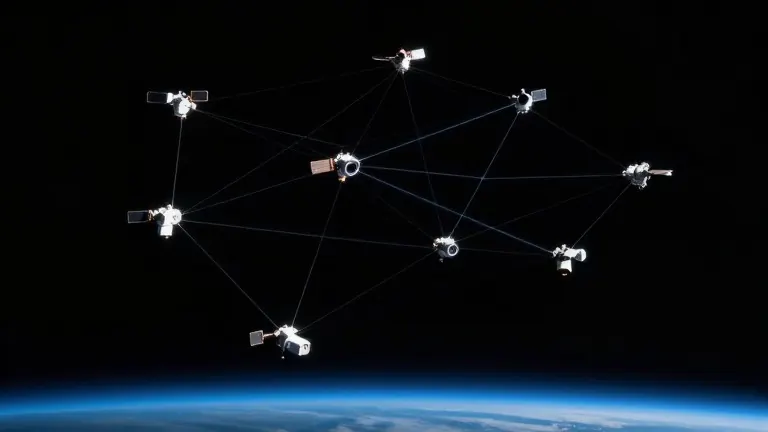
Among them is Anish Roshi Damodaran, a professor at the University of Central Florida. His team will receive $175,000 to study a concept called PHOENIX. The project aims to build a virtual super telescope using up to 25 separate spacecraft.
The acronym stands for Photonics-Enabled Heterodyne Submillimeter/Far-Infrared Interferometer. The design uses advanced photonic technologies to link the satellites. Working together, the group would function as a single, massive instrument. This setup allows for ultra-high-resolution observations at submillimeter and far-infrared wavelengths. These wavelengths capture cold gas and dust that are invisible to the human eye.
Current telescopes struggle to resolve fine details in planet and star formation. A single large telescope faces launch size limits. Splitting the power across smaller satellites creates synchronization and data processing challenges. Damodaran notes that existing facilities detect the material but cannot directly resolve the critical structures where these processes occur. PHOENIX aims to fix this by resolving structures on scales comparable to the inner solar system.
The research team includes experts from UCF and NASA’s Jet Propulsion Laboratory. Partners include Peter Delfyett, Guifang Li, Stephen Eikenberry, Julie Brisset, and Yan Fernandez. JPL researchers Jacob Kooi and Jonathan Kawamura also contribute. Damodaran previously led radio astronomy for the Arecibo Observatory. He continued his work at UCF after the telescope collapsed in 2020.
The nine-month award funds early development and feasibility studies. The team will define the mission architecture and identify critical enabling technologies. They will also evaluate performance requirements and assess technology readiness. Damodaran attended the NIAC orientation symposium to meet other fellows. He described the process as feeling like a second Ph.D. thesis because it requires questioning assumptions and exploring alternative approaches.
NASA plans to make six to eight Phase II awards and one Phase III award annually. Phase II provides up to $750,000 for two years of further development. Phase III provides up to $2 million for another two years. These stages aim to transition high-potential concepts to government or commercial partners.
Source: UCF Today