Ballot Order May Give Florida GOP 3 Point Boost
A 1951 law places the party that last won the governor's race at the top, a position experts say provides a measurable advantage in close elections.
By Beatriz Bailey ·

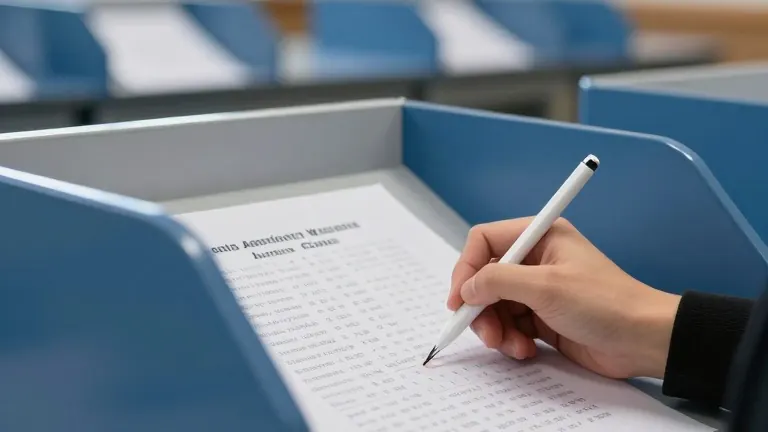
The Republican candidate appears above the Democrat on every Florida general election ballot.
A 1951 state law dictates this order. The top spot goes to the party whose candidate won the previous governor's race. Republicans hold that position in 2026 because Ron DeSantis won reelection in 2022. This arrangement has persisted for more than 25 years, dating back to the victory of Jeb Bush.
Political scientists identify a psychological bias known as the primacy effect. Jon Krosnick, a Stanford University researcher, explains that voters often select the first acceptable option presented to them. This happens because of limited information and voter ambivalence. Krosnick noted that the effect is visible in various choices, from beer tasting to crossing parking lots. He stated that the first option receives a slight advantage in competition.
Darren Grant, an economics professor at Sam Houston State University, found that this effect is most pronounced in down-ballot races. He linked the ballot order to narrow Republican victories in recent gubernatorial contests. Charlie Crist won the governorship in 2006, which placed Republicans first in the 2010 race. Rick Scott won that election by approximately 1.2 percent. Scott won reelection in 2014 by just over one point. Ron DeSantis defeated Andrew Gillum by 0.4 percent in 2018. Grant described this sequence as a hat trick, where an initial win secured future advantages.
Krosnick estimated that the primacy effect can add two to three percentage points to a Republican margin of victory in tight races. Grant emphasized the value of such a bump. He said candidates spend millions of dollars on advertising to gain one or two percentage points. The effect can weaken in high-publicity races where voters know the candidates well. However, negative campaigning can increase ambivalence, thereby strengthening the bias toward the top position.
Democrats challenged the law in federal court in 2018. A lawsuit argued that the position bias created an unfair electoral advantage. The National Republican Senatorial Committee and the Republican Governors Association defended the statute. They argued that the top placement imposed only minimal burdens on constitutional rights. U.S. District Judge Mark Walker ruled in favor of the plaintiffs. An appeals court overturned that decision in 2020. The judges determined the plaintiffs lacked legal standing and that the case involved political questions beyond judicial authority.
Florida is one of at least a dozen states that use political party affiliation to determine ballot order. A 2025 analysis by the National Conference of State Legislatures confirmed this practice. Other states use different methods. Some arrange names alphabetically. Others use random drawings or rotate names across different ballots within the same election. West Virginia faced a similar legal fight. Its top spot goes to the party whose presidential candidate won the state in the last election. A federal judge initially sided with Democrats there, but an appeals court later overturned the ruling on different legal grounds.
Source: WUWF