House Control Hinges on 46 Tight Districts in New Maps
With polls open, Democrats need a net gain of three seats to flip the House, a margin that depends on performance in seven states with redrawn boundaries.
By Beatriz Bailey ·
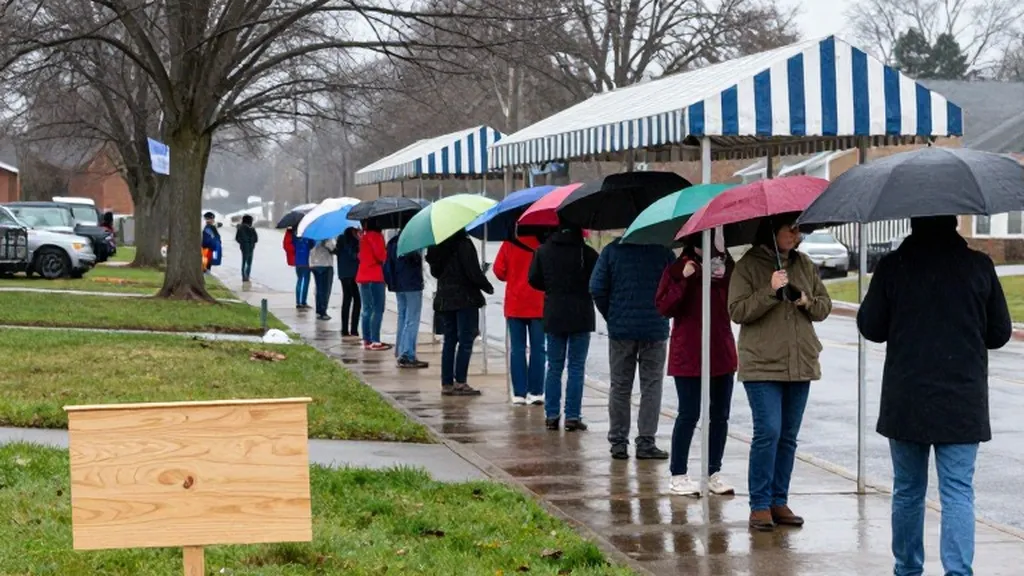
Voters across the United States are casting ballots on Tuesday, November 3, 2026, to determine which party will control the U.S. House of Representatives for the final two years of President Donald Trump's second term. All 435 seats are up for election, making this a complete turnover of the chamber. The current balance of power is tight, with Republicans holding 218 seats and Democrats holding 214 seats, plus one independent. This configuration leaves the majority threshold at 218 seats, creating a razor-thin margin for both parties.
The Associated Press reports that Democrats need a net gain of three districts to secure a majority in the House. Conversely, Republicans can afford to lose no more than two seats to maintain their control. This mathematical reality has led political analysts to focus on 46 battleground districts identified by Ballotpedia. Of these contested seats, 25 are currently held by Democrats and 21 by Republicans. The outcome in these specific areas will likely determine the overall control of the chamber, as most other districts are considered safe for their respective parties.
A significant factor in this election is the use of new congressional maps in seven states: California, Florida, Missouri, North Carolina, Tennessee, Texas, and Ohio. These maps resulted from mid-decade redistricting efforts. In the Southeast, voters in Florida, North Carolina, Tennessee, and Georgia are using these new boundaries to cast their ballots. The AP notes that Republicans attempted to beat the historical midterm pattern, where a president's party almost always loses seats, through these redistricting efforts. However, Democrats argue that the new districts may not vote as they were drawn, particularly in states where the maps were contested in court.
In Georgia, where polls are open from 7 a.m. to 7 p.m., voters are deciding not only the House but also the fate of the state's new congressional lines. The state is a key location for the Democratic push, as several of the new districts are competitive. In Florida, where polls are also open from 7 a.m. to 7 p.m., the new map is central to the race for House control. The AP indicates that 88.1% of Republican general election TV ad spending went to states and districts Trump won in 2024, including areas where he won by 10 points or more. This spending strategy highlights the Republican focus on defending their base while trying to hold the House majority.
North Carolina, with polls open from 6:30 a.m. to 7:30 p.m., is another critical state with a new map. The state has a mix of competitive districts that could swing either way. Similarly, Tennessee, where poll hours vary by county, is using a new map for this election. The AP notes that 21 Democratic-held districts voted for Trump in 2024, while nine Republican-held districts voted for Kamala Harris. These overlapping preferences suggest that voters in these battleground districts are likely to be decisive in the House race, as they may prioritize party loyalty or the president's performance over their 2024 vote.
The mood in these districts is described by the AP as a referendum on the president's second term, with many voters struggling with high prices and anger over an unpopular war with Iran. AP-NORC polling shows that 35% of U.S. adults approve of Trump's job performance, while 25% approve of his handling of the economy. About 7 in 10 voters say the country is heading in the wrong direction. This sentiment is driving turnout in the 46 battleground districts, where both parties are intensively campaigning. More than 57 million people had already voted as of Monday, surpassing early vote totals from four years ago in many closely watched states.
Republican National Committee Chairman Joe Gruters stated, "Everything depends on turnout. If we turn out our voters, we win, and that's what we've been planning for." In contrast, House Democratic Leader Suzan DelBene said, "The American people are angry. They want change." These quotes reflect the strategic focus on mobilizing base voters in the tight districts. In the Southeast, voters like James Moore, a 57-year-old librarian in Raleigh, North Carolina, said, "I'm paying more taxes. I'm paying more for my healthcare. I'm paying more for everything." His comments capture the economic anxiety that is influencing voters in the new districts.
The election is also significant for the administration's legal battles. A federal judge temporarily barred the Trump administration from carrying out a plan to prevent noncitizen voting, a move that critics say risks disenfranchising eligible voters. The administration sued in Alaska and California, and Democrats fear interference and intimidation as the Justice Department threatens to prosecute local election officials. These legal challenges could impact how votes are counted and certified in the battleground districts, adding another layer of uncertainty to the House race.
If Democrats win even one chamber, investigations and possible impeachment proceedings become likely. House Democratic Leader Hakeem Jeffries would be the first Black speaker if the Democrats take the House, and he has outlined a 100-day agenda on the cost of living and oversight. A strong Democratic night would also boost potential 2028 candidates like Gavin Newsom, JB Pritzker, and Pete Buttigieg. For Republicans, holding the House is crucial to maintaining their legislative agenda and protecting the president from oversight. The three-seat margin in the House makes every vote in the 46 battleground districts critical.
In the Southeast, the new maps in Florida, North Carolina, Tennessee, and Georgia are likely to be the deciding factor in the House race. The AP notes that Republicans were bracing to lose the House and fighting to hold the Senate, with one or two seats potentially tipping either chamber. The focus on the 46 battleground districts reflects the narrowness of the margin for error. As polls close in these states, the final tally will reveal whether the new maps helped Republicans hold their majority or if Democrats were able to capitalize on voter sentiment to gain the three seats they need for control.