Oleshky Truce Faces Scrutiny as Lavrov Heads to Atlanta for G20
Fourteen days after a local ceasefire began, 1,700 civilians remain in the occupied town while US lawmakers warn of forced deportations.
By Noah Ross ·
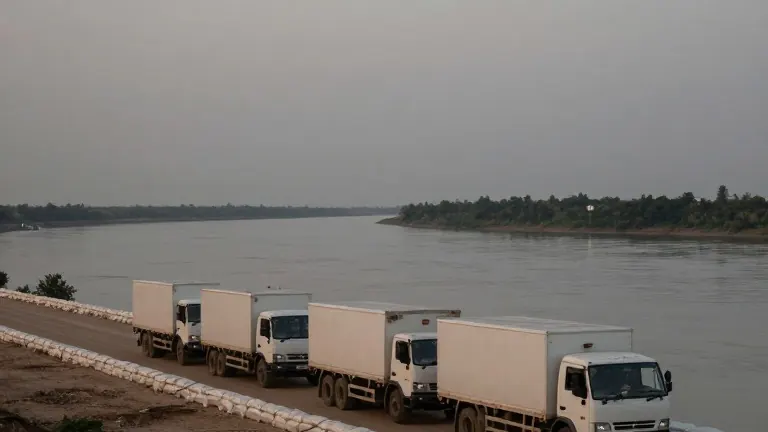
The localized ceasefire around the Russian-occupied town of Oleshky entered its third day on October 29 with no reported violations, yet uncertainty remains over the fate of the 1,700 to 2,000 civilians still trapped inside. The pause, brokered with the involvement of US first lady Melania Trump, took effect on October 27 and is scheduled to last until November 1.
Ukrainian officials and US representatives confirmed that the truce has held so far, but humanitarian advocates warn that the window is closing for safe evacuation. The town, situated across the Dnieper River from Kherson, has been under Russian control since 2022. Residents face severe shortages of food, medicine, and electricity, with regular road deliveries of supplies halting in May 2026.
The Congressional Ukraine Caucus issued a statement on October 28 welcoming the truce while warning against Russian attempts to forcibly transfer residents. Co-chairs Marcy Kaptur, Mike Quigley, Brian Fitzpatrick, and Joe Wilson stated that moving civilians from occupied territory constitutes a war crime. They urged Moscow to allow residents to choose their destination rather than coercing them toward Russia or Crimea.
Dmytro Lubinets, Ukraine's human rights ombudsman, said preparations for the humanitarian mission are underway under an agreement with Russia. He worked with Russian human rights commissioner Yana Lantratova to coordinate the effort. Melania Trump announced that four Newsmax journalists would accompany the operation to document the process, a move that some advocates view as insufficient.
Daniel Balson, director of advocacy for Razom for Ukraine, criticized the lack of independent oversight. He noted that there is no provision for monitors from the International Committee of the Red Cross or the United Nations to verify consent. Balson warned that Russian President Vladimir Putin could use the operation to deport nearly 2,000 civilians, including children, to Russian-controlled territory.
Yuriy Boyechko, chief executive of Hope for Ukraine, alleged that Russian forces are preventing civilians from crossing to Ukrainian-controlled territory. He claimed that troops are moving heavy armor and artillery toward the riverbanks during the pause, potentially preparing for a renewed offensive to retake Kherson.
The diplomatic stakes rise further as Russian Foreign Minister Sergei Lavrov travels to Atlanta for the G20 foreign ministers meeting on October 30 and 31. The visit places him in the same city as US Secretary of State Marco Rubio, though no direct meeting has been confirmed. Lavrov's attendance has drawn criticism from lawmakers like Don Bacon, who argued that Russian leaders should not be welcomed at international forums while the war continues.
Source: RFE/RL